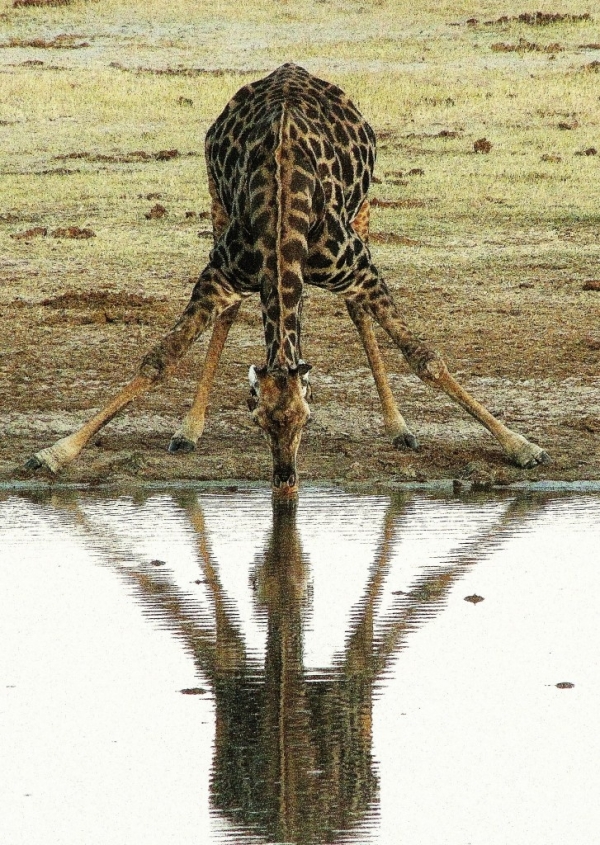
Hwange National Park is one of Africa's finest havens for wildlife and is home to vast herds of elephant, buffalo, zebra and has a very large concentration of giraffe. It is also home to many predators and endangered species plus very large and varied birdlife.The park is situated on the main road between Bulawayo and the world famous Victoria Falls.Hwange National Park covers just over 14 600 square kilometres. The Park carries 105 mammal species, including 19 large herbivores and eight large carnivores. Elephant make up the largest proportion of the biomass.All Zimbabwe's specially protected animals are to be found in Hwange and it is the only protected area where gemsbok and brown hyena occur in reasonable numbers. The population of wild dog to be found in Hwange isShow morethought to be of one of the largest surviving groups in Africa today.The landscape includes desert sand to sparse woodland as well as grasslands and granite outcrops. Due to the lack of water, man-made waterholes were introduced to sustain the animals through the dry season. The park has an interesting variety of landscapes with one part running alongside the North-eastern end of the Kalahari desert. The south is sandy with extensive forests and open grassland. A feature of the area is ancient fossil dunes - ancient sand dunes held together by vegetation.Walking, driving and horseback safaris are a popular way of seeing the wildlife. Accommodation is provided at a number of game Lodges.To travel through Hwange National Park today is to see what much of the interior of Africa might have been like more then 150 years ago.Main CampMain Camp is situated at the main entrance to the Park. There are numerous pans and pumped waterholes around Main Camp and the area is rich in game.FacilitiesMain Camp has facilities including self-catering lodges, cottages and chalets, a camping and caravan site, bar and restaurant, grocery store, curio shop and petrol station.Main AttractionsMain CampMain Camp is situated at the main entrance to the Park. There are numerous pans and pumped waterholes around Main Camp and the area is rich in game.FacilitiesMain Camp has facilities including self-catering lodges, cottages and chalets, a camping and caravan site, bar and restaurant, grocery store, curio shop and petrol station.LodgesLodges in Hwange National Park are units with one or two bedrooms, bathroom, fully equipped kitchen with refrigerator and stove, lounge and veranda. Cooking utensils, cutlery and crockery are provided.CottagesCottages are units with 1 or 2 bedrooms, bathroom and veranda. Cooking facilities are communal, with electric hot plates provided. The cottages have a centrally located thatched, open dining area with refrigerators available for communal use. Normally no cutlery or crockery is provided.ChaletsThese are units with 1 or 2 bedrooms, and a veranda. Cooking facilities are available on wood or charcoal braais. Electric refrigerator and sink are provided in each unit. Ablution and toilet facilites are provided in a communal block.Camping and Caravan sitesCamping and caravan sites have piped water to each stand. Cooking facilities are available on wood or charcoal braais. Ablution and toilet facilities are provided in communal blocks. Visitors should note that tent and camping equipment are not available for hire.Conference FacilitiesConference facilities can be made available at Main Camp. Visitors who intend to hold a conference or an organized gathering requiring such facilities will need to contact the Central Reservation Office for details.Attractions & ActivitiesNgweshla Pan â the loop road is a pleasant day-driveNyamandhlovu Platform â prime game viewing area at a pumped water holeDom waterhole â an exceptional view of the African SunsetAmenitiesRestaurant and barGrocery storeCurio shopFuel station â please note petrol deliveries are not reliable so visitors have to take precautionary measuresSinamatellaEstablished in 1966, this part of the Park was a former cattle ranch. The camp is located near the northern boundary of the Park on an outcrop, 55 metres high, overlooking a distant riverbed and grassy plain. The name Sinamatella is a distortion of the name of a local shrub called âchinamatiraâ which characteristically will stick to clothing when brushed against.The Camp is approximately 120 kilometres from Main Camp. Vehicles are not allowed to travel between the two camps after 1400 hours. Sinamatella is an Intensive Protection Zone (IPZ).FacilitiesThe Camp has lodges, chalets and camping sites as described in Main Camp. In addition, a restaurant, bar, shop and fuel are available. Apart from these facilities at the Rest Camp there are also several exclusive camps in the area:Exclusive CampsBumbusi CampBumbusi is situated 24 kilometres northwest of Sinamatella and consists of 4 âAâ frame accommodation units, a cottage and a central lounge area. The kitchen is fully equipped with freezer and stove. A central ablution block comprises 2 toilets and 2 bathrooms. The maximum number of persons that may be accommodated at Bumbusi is 12. There are no electricity facilities available. The access road is rough, but can be negotiated by low clearance vehicles in the dry season.Lukosi CampLocated 11 kilometres from Sinamatella. With facilities similar to Bumbusi, the maximum number of occupants is 10. Lukosi Camp is only available for bookings from November through April.Bush CampsThese are undeveloped sites found at Lukosi, Vhikani, Rhino Bar, Salt Springs and Tshakabika. Four wheel drive or high clearance vehicles are necessary for visitors to Tshakabika.Attractions & ActivitiesMandavu Dam â provides a beautiful viewing hide to watch animals coming to drink, 27 kilometres from SinamatellaMasuma Dam â excellent hide for game viewing about 15 kilometres from SinamatellaDetema Dam â exceptional game viewing hideWilderness trailsWalksFishingAmenitiesRestaurant and barSmall shopFuel station â please note petrol deliveries are not reliable so visitors have to take precautionary measuresRobinsRobins Camp is close to the western boundary of Hwange approximately 60 kilometers from Sinamatella and 140 from the Main Camp. Through traffic from Main Camp is required to leave by 1200 hours. This camp was bequeathed to the government in 1939 by a local farmer, Harold Robins.FacilitiesThe Camp has lodges, chalets and camping sites. In addition, a restaurant, bar, shop and fuel are available. There are also several exclusive camps in the Robins area:Exclusive CampsNantwich CampThe Camp consists of 3 lodges and is located 11 kilometres northwest of Robins Camp. Each lodge is fully equipped and self-contained. This remote camp is built on a small bluff which overlooks a natural pan and grassy plain.Isilwane LodgeThis luxurious lodge is a top of the range accommodation facility overlooking an artificial waterhole. The lodge is only a few metres away from Nantwich Camp.Deka CampDeka Camp consists of 2 family units, each with 2 bedrooms, bathroom and toilet. An additional facility contains a dining room, lounge, scenic verandah and kitchen with refrigerator and stove. The camp is serviced and fully equipped and takes a maximum of 12 persons. Deka Camp is situated 25 kilometres west of Robins Camp. Access is by four-wheel drive vehicles only. The camp is normally closed during the rainy season.Attractions & ActivitiesBig Toms & Little Toms â these are viewing hides which provide excellent game viewing opportunities and are named for the farms of Harold Robins who bequeathed his land to the Park in 1939.AmenitiesRestaurant and barSmall shopFuel station â please note petrol deliveries are not reliable so visitors have to take precautionary measuresOther ActivitiesEscorted daytime walks â available from all camps for a charge to groups of up to 6 personsMoonlight game viewing â available from Main Camp around the full-moon period subject to weather conditionsWilderness trails â available in the Sinamatella and Robins Camp areasPicnic SitesCamping is permissible in Hwange National Park at Shumba, Kapula, Mandavu Dam, Masuma, Ngweshla, Jambile, Kennedy 1, Guvalala,and Detema Picnic Sites. Each site consists of an enclosed picnic area (usually with shady trees or thatch cover) and a small ablution block with running water. Groups of up to 10 people may camp overnight at these areas but the sites are also open to all visitors during daytime.


Share on